- Date | 02 February 2024
- Location | Utrecht
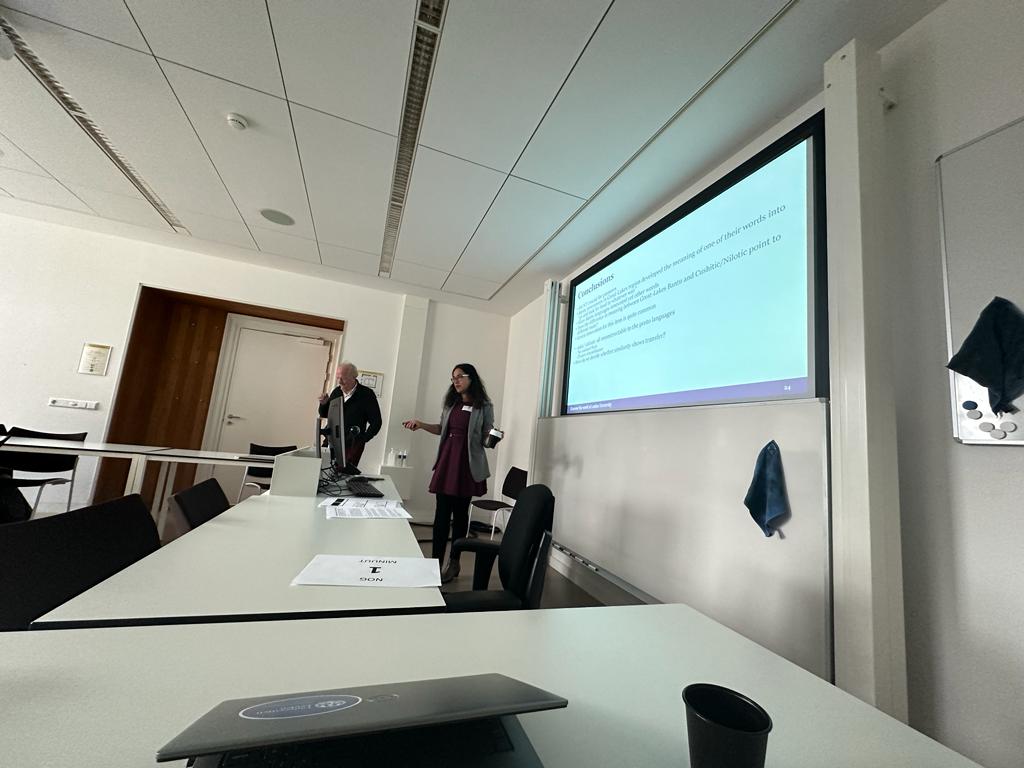
Presentation by Maarten Mous and Nina van der Vlugt: “Hunting the word for ‘hunt’ through time in East Africa”
Abstract: Within our project on the linguistic history of East Africa, www.lheaf.org, we trace the journeys of certain words across languages and language families. A particularly interesting word to study is the verb ‘to hunt’. This central activity of food production has spread in complex ways across languages. A major challenge is that there are two similar, probably related points of departure: There is the verb root –sak– going back to reconstructed Proto Bantu *cak ‘to hunt’ and there is *ɬakaat ‘to hunt’ reconstructed for Proto South Cushitic and with the same shape for Proto South Nilotic. The latter form has spread to a number of Bantu languages in Northern Tanzania but also to Sandawe (though themselves traditional hunter-gatherers). This root without the ending –aat is present sporadically in other Cushitic and Omotic languages, as well as in Kuliak. The reconstructed meaning for Great Lakes Bantu is wider, ‘find food, trade or work for food’ (Schönbrun 1977): we need to address semantic developments too on top of the intricate developments of form.
Presentation by Alba Hermida Rodríguez: “Sandawe-Cushitic language
contact in early Tanzania”
Abstract: This study presents preliminary findings on early language contact between Sandawe (Khoisan) and (South) Cushitic languages. By examining lexical borrowing, we seek to provide evidence suggesting that the transition from hunting-gathering to pastoralism was so gradual that mixed practices may have emerged early on. This challenges the traditional belief that pre-Bantu archaeological evidence in Tanzania is Cushitic; instead, it could be indicative of Khoisan practices. We created a comprehensive database of around 400 loanwords extracted from Ehret & Ehret’s dictionary (2012) and Kiessling & Mous Proto-West Rift reconstructions (2003). The identified Sandawe-Cushitic connections were assessed based on their reliability and likelihood, and loan directionality to or from Sandawe was assigned. The loanword analysis focuses on aspects such as morphological adaptations, phonological changes, and semantic field evaluation (mainly focusing on those linked to hunter-gatherer and pastoralist practices). Relating these factors to Sandawe-Cushitic or third language (i.e., Bantu, Nilotic, etc.) borrowings will construct a linguistic map, delineating the contact layers and offering insights into the nature of early interactions and shared practices.


 LHEAf
LHEAf 